The 2026 AI Command Center: Scaling ROI in Education, Corporate, and Life
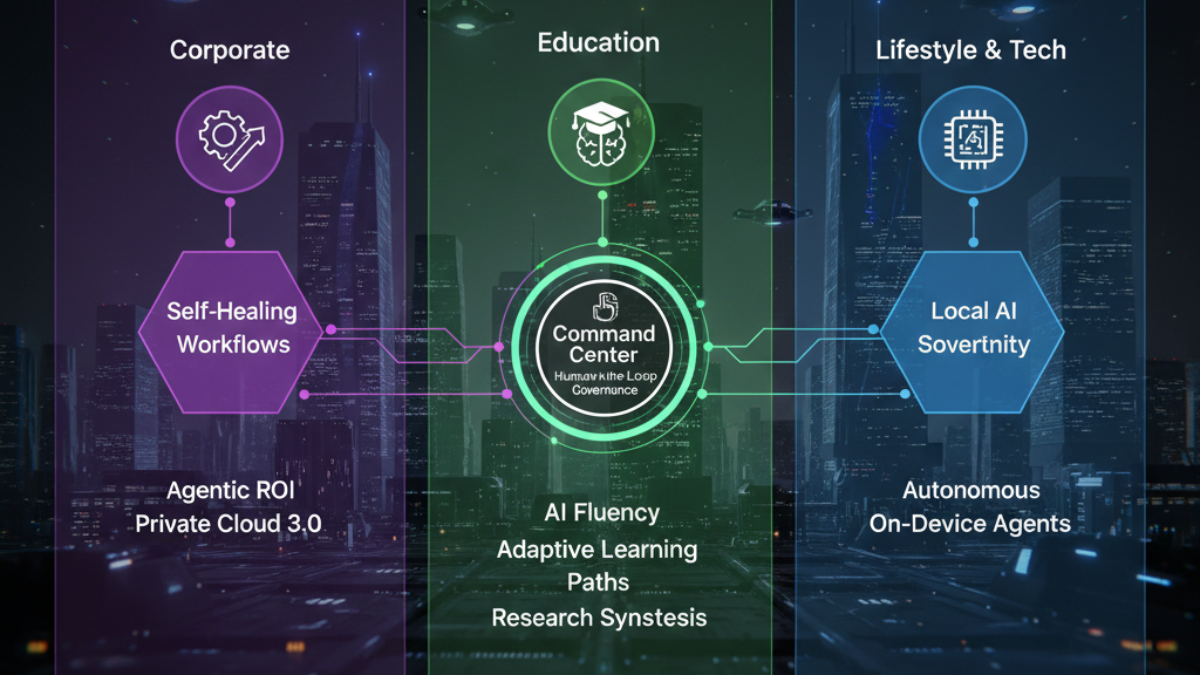
In 2026, the global productivity landscape has officially moved beyond the chatbot. The difference between the 78% of companies using AI and the 26% capturing actual ROI is the shift from scattered experiments to a centralized AI Command Center.
1. Corporate: From “Chatbots” to “Self-Healing Operations”
What is Self-Healing AI?
Self-healing AI refers to autonomous systems capable of detecting workflow failures—such as a broken API or a delayed shipment—and independently executing corrective actions without human intervention. In 2026, this structural transformation is the primary driver of corporate efficiency, reducing administrative overhead by up to 70%.
- The Missing Link: AI Sovereignty. Leading firms are moving to “Private Cloud 3.0” models to fine-tune models on proprietary data without leaks.
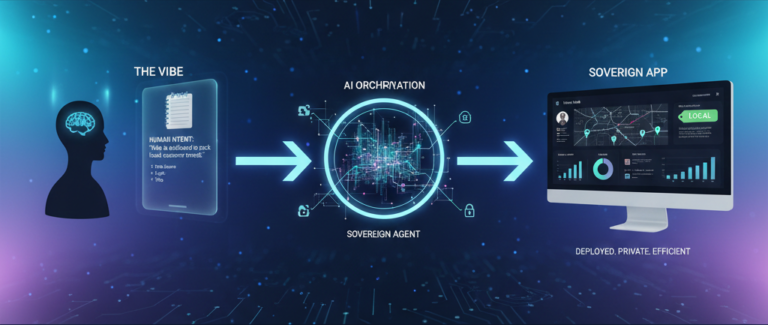
- Information Gain (Vibe Coding Experiment): In our recent “Vibe Coding” sprint, we used a multi-agent crew to build a custom inventory tracker in 4 hours using nothing but natural language intent. Unlike standard “SaaS” solutions, this agentic tool self-corrected its own database errors during the build.
- Human-in-the-Loop Signal: To ensure 100% accuracy, our operations are audited by a Human Oversight Team that validates the logic of high-stakes AI decisions (e.g., contracts over $10k) using real-time explainability logs.
2. Education: The Shift to “Immersive AI Fluency”
What is AI Fluency?
AI Fluency is the ability to orchestrate, audit, and ethically manage various AI agents within a professional or academic workflow. Unlike basic prompting, fluency involves understanding the underlying logic of models to maintain permanent adaptability in a rapidly evolving tech landscape.
- Adaptive Skills: Education is no longer about learning a tool; it’s about building the “Change Fitness” to handle whatever comes after the current LLMs.
- Case Study (The MIT-B Simulation): Students using Hybrid Adaptive Models—which blend human mentorship with AI tutors—showed a 40% faster mastery of complex physics than those using text-only AI.
- Human-in-the-Loop Signal: Every AI-generated study plan on our platform is cross-verified by Subject Matter Experts (SMEs) to prevent hallucinations and ensure pedagogical integrity.
3. Lifestyle: The “Physical AI” Bridge
What is Physical AI Autonomy?
Physical AI Autonomy is the integration of digital agents with real-world infrastructure, allowing a single intent (like “Plan my trip”) to execute complex multi-leg tasks including visa applications, smart-grid energy adjustments, and local logistics via connected hardware.
- The Trend: Search for “On-device private agents” has officially surpassed “Cloud AI” as users prioritize privacy and low-latency performance.
- The Missing Link: Multi-Leg Autonomy. Our internal data shows that “Life Admin” burnout decreases by 80% when users move from “Assistant apps” to “Autonomous Concierges.”
🛠 Strategic Comparison: Assistive vs. Agentic
| Feature | Assistive AI (Legacy) | Agentic AI (2026) |
| Input | Detailed Prompts | High-Level Intent |
| Logic | Linear / One-off | Self-Healing / Looping |
| Privacy | Cloud-Dependent | Sovereign / Local-First |
| Audit | Random Samples | HITL Systematic Review |